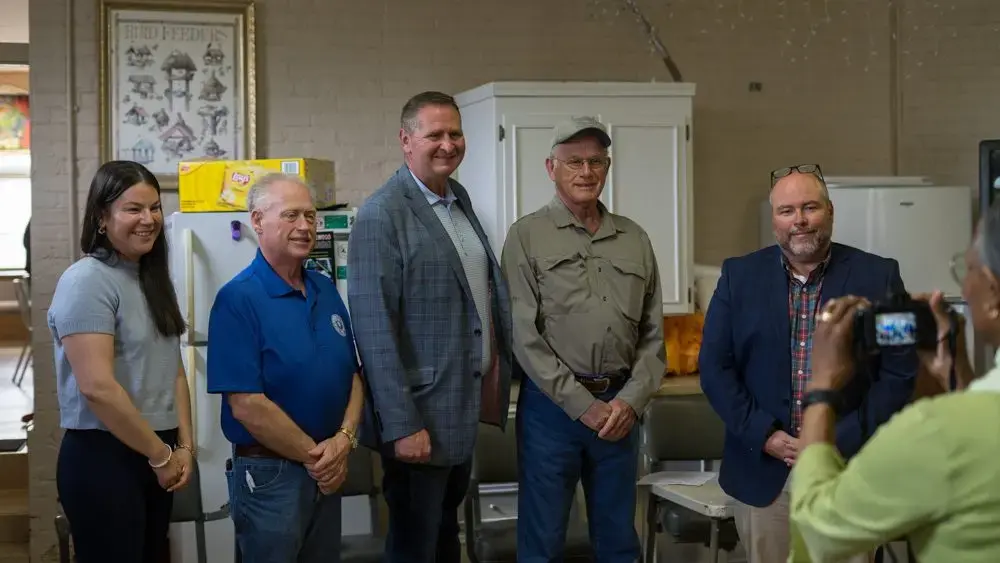


Christian County Judge-Executive Jerry Gilliam on Tuesday outlined lower taxes, job creation, infrastructure investment and a renewed focus on Fort Campbell during a State of the County address to the Christian County Agribusiness Association.
Gilliam said the county has focused on economic development while reducing the tax burden on property owners.
“Our little bit of accomplishments, we could talk about each one of those, but we did create some jobs, we have lowered the taxes, and we have and continue to make infrastructure improvements,” he said.
Gilliam said the county’s real property tax rate has declined over the past three years.
“The admiral lowered tax is now setting right there at 16.7, last year it was 17.6, so we have been able to drop the property tax rate 90 points and we think that’s huge,” he said.
He acknowledged that reassessments have increased valuations for some property owners but said the county made a conscious decision to offset that impact.
“As a result of reassessments, we’ve taken the notion to go on and make sure that we do our part,” Gilliam said. “So hopefully you have seen a reduction in your taxes as far as the check that you have written.”
Gilliam said Christian County relies almost entirely on property taxes for revenue, unlike many Kentucky counties.
“One thing that’s unique about Christian County is that’s about the only tool that we have in our toolbox as far as revenue is concerned,” he said. “So we do not have an occupational tax, but many counties do. And that’s their primary source of revenue.”
He said the county also does not levy an insurance premium tax, which increases reliance on property taxes.
Gilliam noted that more than half of Christian County households are rentals, raising questions about how the tax burden is shared.
“When 56% of the households in Christian County are rental, how many parts, how many people of Christian County are really paying their way into the county revenue stream?” he said.
Despite rising property values, Gilliam said housing growth remains key to broadening the tax base.
“We’re over a $5 billion base from a tax base perspective,” he said. “The more houses that we have, more rooftops we have, the more property tax that we can create.”
Gilliam said the county established strategic goals in 2023 following a countywide survey that drew more than 500 responses.
“A lot of those responses went into our fiscal court setting down and creating some strategic goals that we want to focus on,” he said.
Among those goals are strengthening ties with Fort Campbell, supporting agriculture-based economic development, expanding housing and maintaining fiscal discipline.
“Fort Campbell is truly an asset to our community. They are truly a part of our fabric of our community,” Gilliam said.
He said the county is working to better leverage agriculture as a foundation for job creation.
“Agriculture is our mainstay. It’s the reason we’re all here,” Gilliam said. “If industry left, agriculture would still be here.”
Gilliam said population growth and homeownership are key to addressing long-standing poverty.
He tied economic growth to reduced incarceration costs, calling county jails one of the largest financial burdens statewide.
“If you ask most counties of the 120 counties in the state, what’s one of their biggest financial burdens, they will quickly say the jail,” Gilliam said.
Gilliam said Christian County’s jail generates revenue by housing state, federal and ICE inmates, but pointed out prevention through economic growth.
On capital projects, Gilliam addressed recent discussion of courthouse renovations estimated at $50 million.
“That does not mean that we’re going to bond or immediately look at trying to finance 50 million dollars,” he said. “That has to be through grants and through tax credits.”
Public safety remains a priority, Gilliam said, noting that about 43% to 44% of the county budget goes to the sheriff’s office.
“I applaud Sheriff DeArmond on the job that he does, the professionalism he brings each and every day,” Gilliam said.
Gilliam showcased recent and pending job announcements, including Kitchen Foods, which he said could eventually employ 900 people. He also cited the upcoming Buc-ee’s development near Oak Grove, noting road improvements must come first.
“I’m not going to break ground on something that’s going to create 100,000 cars a year and have to navigate around traffic cones,” Gilliam said.
Gilliam also praised the opening of Toyota Boshoku, which employs about 160 workers.
“Those 160 jobs are more of a higher skill that require someone more capable, and those pay better wages too,” he said.
Gilliam said the county continues to work on Commerce Park and other industrial prospects.
When discussing Fort Campbell, Gilliam said Christian County missed early opportunities but is working to strengthen ties. He said Fort Campbell has one of the highest retention rates in the nation for service members who remain in the area after leaving the military.
“That’s something that I think we should be proud of,” he said.
Gilliam also cited the county’s role in securing a waiver that allowed Fort Campbell students to participate in sports during the federal shutdown.
“I know it showcased Christian County because we helped bring that waiver and allowed those kids to play,” he said.
On housing, Gilliam said new construction has increased even as interest rates remained relatively high. He said the county is updating subdivision guidelines that had not been revised since the 1980s, with a focus on preserving farmland while encouraging responsible development.
Gilliam said the county is also focusing on infrastructure upgrades in Oak Grove, including water and sewer projects. He also praised public safety improvements included moving sheriff’s deputies to hazardous duty retirement.
“We felt it was important that’s going to do a couple things it’s going to help retention,” he said.
He also said engineering work is underway for 14 tornado shelters across the county.
“I think it’s important that we provide opportunity for our residents in Christian County to be able to feel safe,” Gilliam said.
Looking ahead to the legislative session in Frankfort, Gilliam outlined several priorities, including Commerce Park 2.
“It is probably the best site for economic development in the region if not this whole southeast,” he said.
He said the county wants to be selective about future industries.
“We want to make it where it fits our park it fits our dynamic it fits our community personality,” Gilliam said.
Other priorities include water projects, improvements to Western Hills Municipal Golf Course and continued funding for the U.S. 115 corridor.
Gilliam also shared the need to protect community assets like the Alhambra Theatre.
“We need to make sure that we protect that because what an asset that Alhambra is,” he said. “It’s certainly a gem.”
Gilliam closed by tying economic development, infrastructure and community preservation together.
“We want to try to be good stewards of you all’s money,” he said.